 Tulum Cenotes
Cenote Prices in Tulum: What Each Gate Actually Charges
Cenote prices in Tulum are unusually hard to pin down because almost nobody publishes them: two parks print a tariff online and the rest take pesos at a wooden window and reset the number when they feel like it. This page puts every gate fee in one table, marks which figures are published and which are reported, sets out what each Tulum cenotes tour collects on the day, and covers the charges - transport, gear, the state tourist fee - that never make it into anyone's budget.
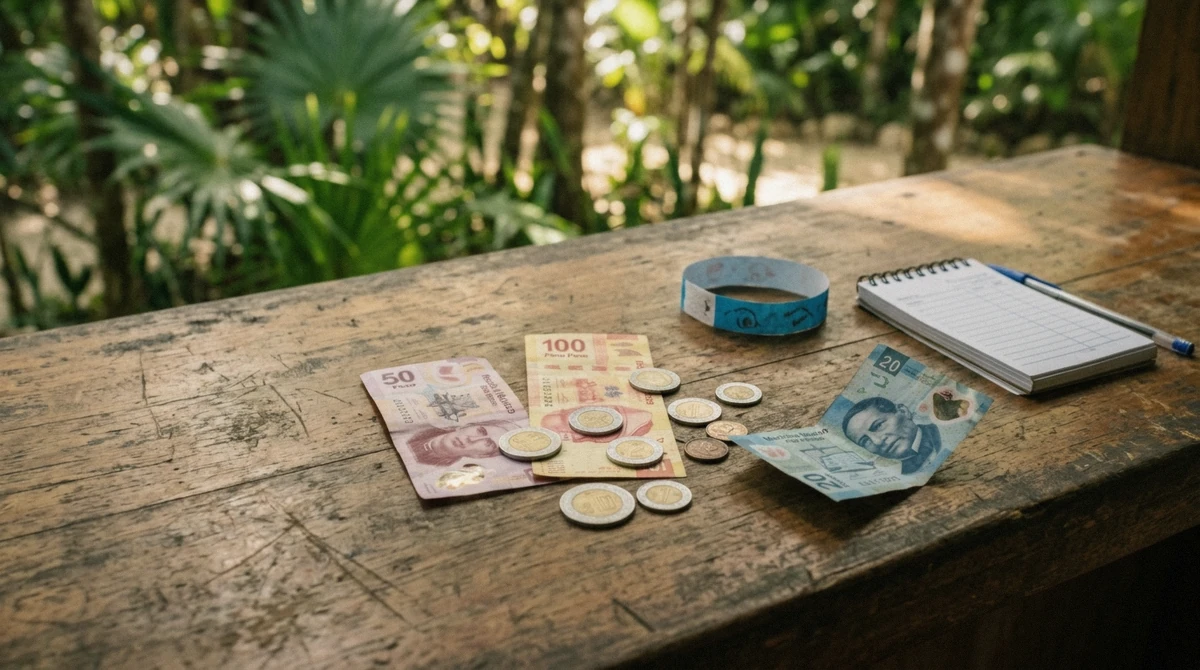
Quick answer Every gate price near Tulum in one table, plus the fees tours collect
Cenote entry near Tulum runs from about MX$200 to MX$500 for a single open cenote, and up to MX$1,200 for a guided cave circuit inside Parque Dos Ojos. Only two parks publish a tariff online: Dos Ojos, whose whole catalogue is on its booking page, and Casa Tortuga, which prints three package prices. Everywhere else takes cash at a window and changes the figure without notice, which is why guides written a year apart quote numbers hundreds of pesos apart. On top of gate money, two coach tours here collect US$40 per adult on the day, and Quintana Roo charges foreign visitors a separate state tourist fee.
Key takeaways
- The full price table covers ten cenotes: published, reported, and what each includes
- Published: Dos Ojos MX$400 entry, MX$800 and MX$1,200 guided; Casa Tortuga MX$650 basic at the gate
- Reported: Gran Cenote about MX$500, Calavera MX$250 plus vest, Zacil-Ha and Kaan Luum about MX$300
- Tour fees are a separate line: two coach days collect US$40 per adult on boarding
- Bring pesos in cash - the gates without a published tariff generally have no card machine
What Every Cenote Near Tulum Charges
Ten cenotes within about half an hour of Tulum, with what each charges and where the figure came from. Published means the park prints it on its own site; reported means it is what visitors and guides said through 2026, and those move upward.
The price table
Read the source column as carefully as the price. A published tariff is a number you can plan around; a reported one is a range that has been drifting up all year, and several 2026 write-ups describe cenote prices around Tulum rising noticeably against 2025.
| Cenote | Adult price | Source | What it includes |
|---|---|---|---|
| Dos Ojos | MX$400 | Published | Swimming in the marked areas of both eyes |
| Dos Ojos guided cavern | MX$800 | Published | Adds the Bat Cave circuit with a guide |
| Dos Ojos full circuit | MX$1,200 | Published | Bat Cave plus entry to Nicte-Ha and Jaguar |
| Nicte-Ha | MX$300 | Published | Open cenote inside the same park |
| Cenote Jaguar | MX$250 | Published | Zip line and 1.5 m and 3 m jumps |
| Casa Tortuga | MX$650 basic at the gate; $24 on a booked day pass | Published | Guided circuit of five cenotes, guide and life jacket |
| Gran Cenote | About MX$500 | Reported | Entry only; life jacket and snorkel rent separately |
| Cenote Calavera | MX$250 to MX$300 plus about MX$50 vest | Reported | Entry, jump hole and ladder |
| Cenote Zacil-Ha | About MX$300 | Reported | Cenote, swimming pool and hammocks; zip line extra |
| Laguna Kaan Luum | MX$300 to MX$350 foreign, less for nationals and residents | Reported | Lagoon only; the deep centre is roped off |
| Casa Cenote | MX$150 lagoon swim on the property's site; about MX$500 reported at the gate | Mixed | Swim; guided snorkel listed at MX$500 |
| Cristalino and Escondido | About MX$200 for both | Reported | Two open cenotes on one ticket |
In dollars
At 16.9 pesos to the dollar, the rate on 4 September 2026, that table runs from about $12 for the cheapest pair of cenotes to about $71 for the full guided circuit at Dos Ojos. A typical two-cenote day for one person lands between $30 and $60 in gate money alone.
Those conversions move with the peso. The pesos do not, which is why every figure on this site is given in the currency the gate actually charges.
What Tours Charge on Top
A booked day is not automatically all-inclusive near Tulum. Some listings prepay every gate fee, others collect a substantial sum on the day, and the difference is bigger than the gap between their headline prices.
Prepaid, collected, or not stated
Three patterns run through the listings compared on this site. Read them against the ticket price rather than instead of it.
| Listing | Ticket | Collected on the day |
|---|---|---|
| Casa Tortuga day pass | $24 | Nothing - the pass is the park entry |
| 4 Sacred Cenotes with rappel | $28 | Nothing; food on site is extra |
| Ruins, Mariposa and Chen-Ha | $26 | US$40 adult, US$20 child for the site and park fees |
| Cenote and Akumal turtles | $84 | US$40 adult, US$25 child in taxes and entries |
| From Cancun | $84 | US$40 adult, US$25 child |
| Triple Adventure | $148 | Not itemised in the listing |
| Three cenotes with lunch | $169 | Nothing - every cenote entrance fee is stated as included |
| Dos Ojos two dives | $118 | Park diving fee about MX$400, gear from US$5 an item |
The comparison that actually matters
A $26 seat that collects US$40 at the door costs a couple $132 before anyone swims. The $169 small-group day collects nothing and includes three cenotes, gear, lamps and lunch. Between those two numbers sits every argument this site makes about cenote pricing.
It is also why the do-it-yourself arithmetic is worth reading before booking anything: with a car, gate prices beat all of it.
The Other Charges Nobody Budgets For
The state tourist fee
Quintana Roo charges foreign visitors a state tourist contribution, collected online through the government's own Visitax portal under Article 51 octies of the state Law of Rights. It is not a cenote fee and no cenote collects it, but it lands on the same trip and is widely reported at around MX$271 per visitor for 2026.
Pay it through the official state portal rather than a third-party site, and keep the QR code on your phone.
Gear, lockers and extras
Life jackets are included at some gates and rented at others - Gran Cenote moved them to the rental hut, Dos Ojos includes them. Snorkel sets rent for a small amount at most parks. Lockers are usually free or a token deposit; one adventure park on this site asks US$20 refundable for a locker key.
Drone flying is charged separately at Kaan Luum, reported at about MX$150, and needs prior permission at Parque Dos Ojos.
Transport, which is the biggest hidden line
Colectivos cost MX$30 to MX$50 on the Coba road and about MX$40 on Highway 307, but they leave you on the road rather than at the gate - two kilometres short at Dos Ojos. Bikes rent for MX$150 to MX$250 a day. A taxi with a wait is the expensive option and often the only practical one late in the day.
For two people, transport frequently costs more than the cenote itself, which is the single reason a booked day catches up so quickly.
Cash, and the missing cash machine
There is no cash point at any of these gates. Cards are taken at Parque Dos Ojos and at some larger parks, sometimes with a foreign-card surcharge; everywhere else it is pesos in hand, and change for a MX$1,000 note is its own negotiation.
Draw money in Tulum town, carry small notes, and budget a little above the figures in the table - every reported number here has moved up rather than down.
Where the Cenotes Sit
The two parks that publish a tariff, Dos Ojos and Casa Tortuga, sit at km 244 and km 239 on Highway 307. The cash-only cenotes are mostly on the Coba road out of Tulum town.
Cenote Prices Near Tulum: Common Questions
How much does it cost to visit a cenote in Tulum?
Between about MX$200 and MX$500 for a single open cenote, and up to MX$1,200 for a guided cave circuit inside Parque Dos Ojos. Only Dos Ojos and Casa Tortuga publish their tariffs; elsewhere it is cash at a window and the number moves.
Do you have to pay to enter cenotes in Tulum?
Yes. Every cenote around Tulum charges, including the ones that look like open jungle from the road - they sit on private or communal land with a gate and a ticket hut. There are no free cenotes worth the drive near town.
Why do cenote prices vary so much between guides?
Because most cenotes publish nothing. A guide written in 2024 quoting MX$150 for Gran Cenote is not lying; the figure has simply moved, and 2026 reports put it around MX$500. Trust published tariffs, treat everything else as a range, and carry extra cash.
Are cenotes cheaper if you book online?
Sometimes, and Casa Tortuga is the clear example: its own basic package at the gate is MX$650 while the booked day pass on a platform is $24, about MX$405. That is the exception rather than the rule - most gates charge the same whether you booked or walked up.
What do cenote tours charge on top of the ticket price?
It depends on the listing. Two coach days here collect US$40 per adult and US$20 to US$25 per child on the day for site and park fees; the small-group cenote day states every entrance fee is included; the dive trip leaves the park's MX$400 diving fee at the gate. The table above sets each one out.
Do I need cash for cenotes near Tulum?
Yes. Parque Dos Ojos takes cards, OXXO and transfers, but most gates are cash-only in pesos and none of them has a cash machine. Draw money in town and carry small notes.
Is there a tourist tax in Quintana Roo?
Yes, a state contribution from foreign visitors, collected online through the government's Visitax portal under Article 51 octies of the state Law of Rights and widely reported at about MX$271 per person for 2026. It is separate from anything a cenote charges. Pay it on the official state portal rather than through a reseller.
Is Tulum expensive for tourists?
The cenotes are the cheap part. A two-cenote day costs roughly MX$500 to MX$1,000 per person in gate money, about $30 to $60, and a colectivo to reach them is MX$30 to MX$50 each way. What pushes a Tulum budget up is the beach zone - hotel-strip restaurants and beach clubs are priced for Los Angeles, not for Quintana Roo. Staying in Tulum town, eating there and using the Coba road cenotes is the version of this trip that costs what people expect Mexico to cost.