 Tulum Cenotes
Cenote Dos Ojos: Prices, Hours and What You Actually Get
Cenote Dos Ojos is two sinkholes joined underwater at km 244 north of Tulum, and the one cenote near town that publishes its whole price list rather than taking cash at a window. Plain entry is MX$400 for an adult; the Bat Cave circuit is a guided MX$800; the gate stops selling tickets at 15:30. This page sets out what each ticket covers, what the cave under it actually is, and which Tulum cenotes tour reaches it.
Quick answer What Dos Ojos charges, what the guided tour adds, and when the gate stops selling tickets
Cenote Dos Ojos is a park, not a single swimming hole: two sinkholes joined below the surface, sitting on 82 kilometres of surveyed cave that was connected to the Sac Actun system in January 2018 to form the longest known underwater cave system on earth. The park publishes its whole tariff online. Plain entry is MX$400 for an adult and MX$200 for a child aged 6 to 11, which buys swimming in the marked areas of both eyes. The guided cavern tour, which adds the Bat Cave, is MX$800, and the full circuit including Nicte-Ha and Jaguar is MX$1,200. The gate opens at 08:00 and stops selling entry at 15:30.
Key takeaways
- Plain entry MX$400 adult, MX$200 child 6 to 11 - the full tariff is published, which is rare here
- The Bat Cave is on the MX$800 guided tour, not on the MX$400 ticket
- Last admission 15:30, so the park guarantees every visitor 90 minutes
- Certified divers pay the park MX$400 on top of their operator's price - the dive day is here
- No transport: a colectivo on Highway 307 leaves you about two kilometres from the gate
What Cenote Dos Ojos Actually Is
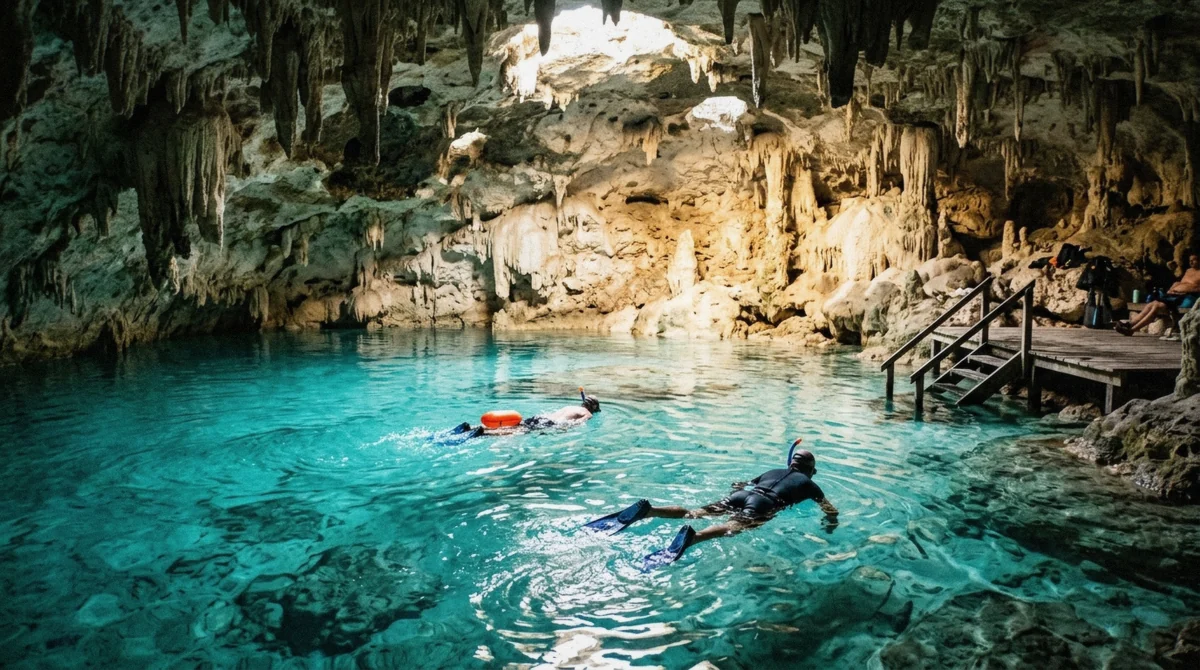
Two round sinkholes about seventy metres apart, joined underwater by a cavern you can swim across. The name means two eyes, and from the air that is exactly what they look like.
The cave under the swimming
What you swim in is the lit end of something much larger. The surveyed Sistema Dos Ojos runs to 82 kilometres, and in January 2018 divers found the connection to the neighbouring Sistema Sac Actun, merging the two into the longest known underwater cave system in the world. The deepest passage anyone has surveyed here, at a spot called The Pit, drops to 119.1 metres, found in 1996.
None of that is accessible to a visitor with a snorkel, and that is the point worth understanding before booking. Swimmers see the daylight zone. Certified divers see the cavern lines. The rest is a technical cave-diving environment that the park sells to nobody as a day trip.
The two eyes, and what the difference is
The east eye is the bright one: shallow, sunlit, with the light coming down through the opening and hitting a sandy floor. It is where snorkellers spend most of their time and where the underwater photographs everyone has seen are taken.
The west eye is darker and leads toward the Bat Cave, a chamber where daylight barely reaches and bats live in the roof. This is the part that is not on the plain entry ticket - it is the guided route, and the park sells it as the MX$800 Tour Dos Ojos or inside the MX$1,200 full circuit.
Fish, and the thing TikTok says about eels
The fauna is small: several species of fish, most of them under ten centimetres, and at least two kinds of freshwater shrimp. That is the whole cast.
Search traffic for this cenote includes a steady trickle of queries about an eel incident, spread through short-video apps. There is no documented incident of that kind in any official park record, news report or dive-industry accident summary that we could find, and the fish here are too small to be the animal in those videos. The real risks at Dos Ojos are the ordinary ones for an overhead environment: certification for divers, staying on the guided line, and not treating limestone steps as dry.
The record nobody mentions on site
On 3 November 2010 the Venezuelan freediver Carlos Coste swam 150 metres through this cave system on a single breath, which stands as a Guinness World Record for the longest distance swum underwater on one breath. It is a useful piece of context for how still and how clear the water is: no current, no swell, and visibility that runs the length of the chamber.
Cenote Dos Ojos Prices, Published in Full
Most cenotes near Tulum take cash at a window and publish nothing. Dos Ojos is the exception, and the figures below come from the park's own booking catalogue, read on 5 September 2026. Admission and opening hours are published by the park itself.
What each ticket buys
Read the middle rows before the first one. The gap between MX$400 and MX$800 is the Bat Cave, and the gap between MX$800 and MX$1,200 is entry to two more cenotes inside the same park. Children aged 4 to 12 pay a reduced rate, under-4s enter free, and the window asks for ID.
The park takes cards, cash, OXXO and SPEI transfers, which is unusual in an area where most gates are cash-only.
| What you buy | Price | What it covers |
|---|---|---|
| Dos Ojos, general entry | MX$400 adult, MX$200 child 6-11 | Swimming in the marked areas of both eyes |
| Tour Dos Ojos, guided | MX$800 | Ojos 1 and 2 plus the Bat Cave; Nicte-Ha and Jaguar not included |
| Tour Completo, guided | MX$1,200 | Ojos 1 and 2, the Bat Cave, and entry to Nicte-Ha and Jaguar |
| Cenote Nicte-Ha | MX$300 adult, MX$200 child | Swimming in the marked area |
| Cenote Jaguar | MX$250 adult, MX$200 child | Swimming, zip line and the 1.5 m and 3 m jumps |
| Misterio Maya or Cenote Monos | MX$1,200 each, guided only | Cave walk and swim; neither is sold as free-swim entry |
| Certified diving | MX$400 Dos Ojos, MX$600 combo with Nicte-Ha, MX$500 El Pit | Park fee only, on top of the dive operator's price |
In dollars, and against a booked tour
At 16.9 pesos to the dollar, the rate on 4 September 2026, plain entry is about $24 and the full guided circuit about $71 per person. Two adults doing the guided circuit are near $142 before transport, which is the number worth holding next to the guided cenote days on this site: the small-group day with lunch is $169 and includes transport, gear and every gate fee at three different cenotes.
That comparison is the honest one. Dos Ojos on your own is cheaper if you only want this park and have a car; it stops being cheaper the moment you need a van for two.
A promotion that changes the maths
The park's booking page has been running a launch banner: buy any MX$960 tour and Nicte-Ha and Jaguar are included free, which does not apply to the MX$640 Dos Ojos tour. Those two figures do not match the MX$1,200 and MX$800 in the catalogue above, so the promotional prices appear to move.
Check the park's page on the day. What does not move is the shape: guided circuits cost roughly double plain entry, and the cave cenotes are guided-only at any price.
Hours, Rules and How to Get There
Opening times, and why the gate shuts early
The park runs 08:00 to 17:00 every day and takes its last admission at 15:30, so that every visitor gets at least an hour and a half in the water. Entry is organised in three blocks - 08:00 to 11:00, 11:00 to 14:00 and 14:00 to 17:00 - and the first block is the quiet one.
That 15:30 cut-off is the single most common way to waste a drive out here. It is also why the answer to why cenotes close at five is really that they stop selling tickets at half three.
The rules that are enforced
Only certified biodegradable sunscreen is allowed, and nothing at all may be applied before you enter the water; there are fresh-water showers at the exit of every cenote in the park. No pets except certified assistance dogs. Drones and professional photography need permission in advance.
Bring a swimsuit already on, a towel, water shoes, dry clothes and cash for anything sold on site. Personal snorkel and dive equipment is allowed; rental is available at the park.
Getting there without a car
The park sits at km 244 on the Tulum to Playa del Carmen highway, north of Tulum town. The four ways in are priced below - colectivo fares and bike rates are what travellers reported through 2026, the tour column is read from the listings on this site.
A taxi is the simple answer for two or more people, agreed before you set off, with the return leg the expensive half. The full breakdown is in visiting the cenotes without a tour.
| How you get there | What it costs | What it involves |
|---|---|---|
| Colectivo on Highway 307 | About MX$40 per person each way | Flag it on the main road, pay cash, get out at the turn-off, then about 2 km in to the gate on foot or by rented bike |
| Bike from Tulum town | MX$150 to MX$250 a day, plus a deposit | Around 20 km each way on the highway shoulder - possible, unpleasant with the trucks |
| Taxi | Agreed with the driver; the return is the costly half | Door to gate, worth splitting between three or four |
| Booked dive trip | Transfer option on the two-dive listing | Collected in central Tulum, park entry still paid at the gate |
What is inside the park besides Dos Ojos
Nicte-Ha, a quiet open cenote with lilies at the edge, and Jaguar, which has a zip line and jump platforms at 1.5 and 3 metres - both sold as plain entry. Misterio Maya and Cenote Monos are cave cenotes and come only as guided tours. El Pit is a dive site, not a swim.
If your day is really about swimming rather than the cave, Cenote Jaguar's MX$250 ticket is the cheapest way into this park, and the jumps make it the one families tend to stay at longest.
Tours That Go to Dos Ojos
Two listings on this site reach Dos Ojos directly - one under water, one for a first dive nearby. Prices and ratings were read from the listings in September 2026; the park's own entry fee is separate on the dive trip and included on the beginner one.
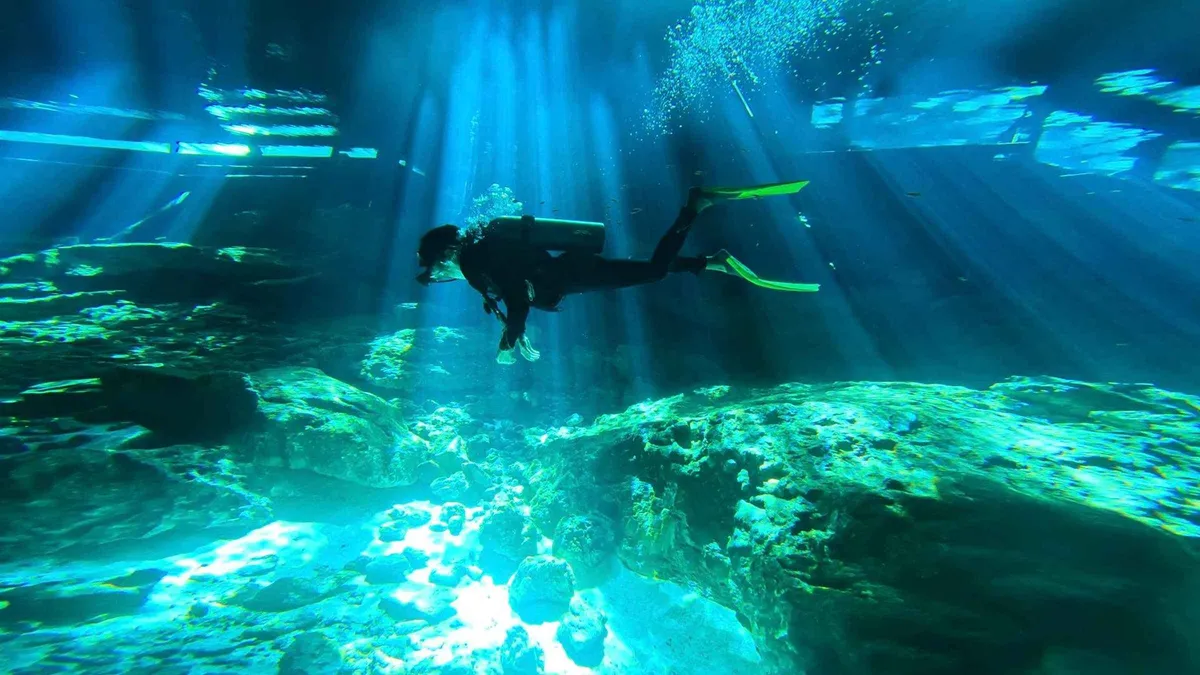
Dos Ojos Cenote: Two Guided Scuba Dives
Two guided cavern dives at Dos Ojos - the bright Barbie Line, then the dark Bat Cave - in a group of four at most, with a guide who has worked these caves for fifteen years. Certification required, and the park's own MX$400 fee is due at the gate.
- Cancellation
- Free cancellation 24h
- Operator
- Diving Cenotes Tulum
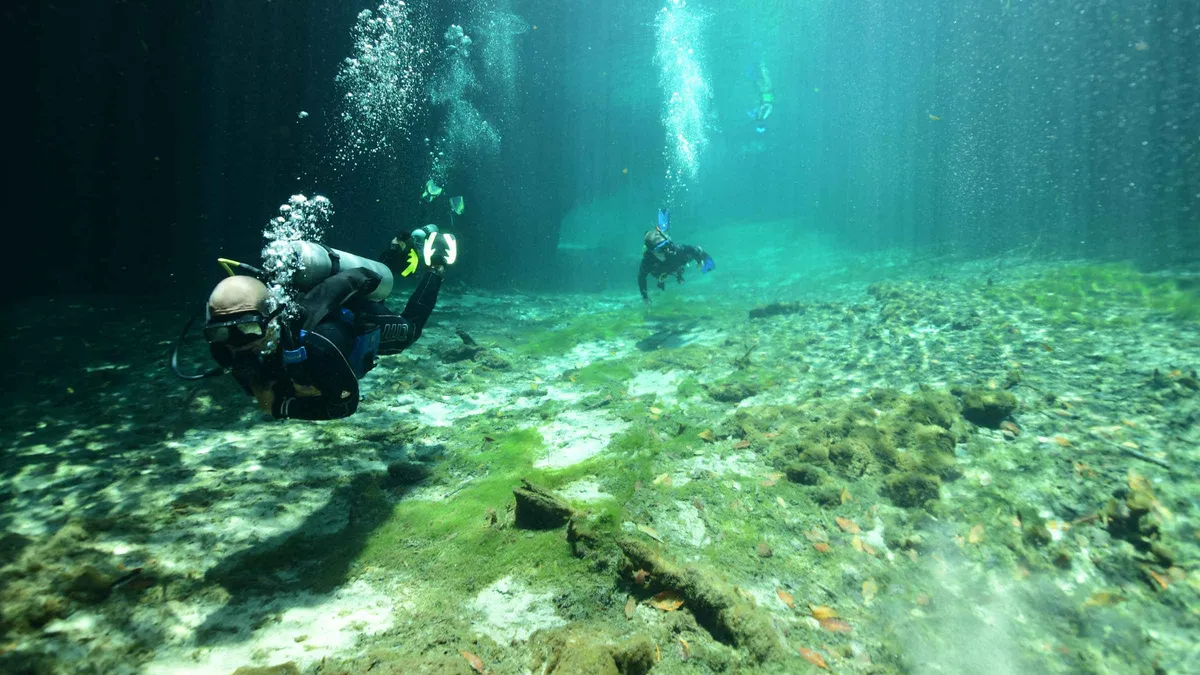
Discover Scuba Diving in a Tulum Cenote
A first dive without a certificate: half an hour of instruction at the shop, then 30 to 50 minutes underwater in an open cenote lagoon ringed by mangroves, four people to one instructor. Entry fee and hotel pickup are already in the price.
- Cancellation
- Free cancellation 24h
- Operator
- Agua Clara Diving Tulum
Dos Ojos and Its Neighbours on Video
The do-it-yourself route filmed end to end, including what the walk in from the highway actually involves.
Where Cenote Dos Ojos Is
Km 244 on the Tulum to Playa del Carmen highway, about twenty minutes north of Tulum town, with the gate a further two kilometres in from the road.
Coordinates published by the park: 20.3165 N, 87.3913 W.
Cenote Dos Ojos: Questions Before You Go
How much does it cost to enter Cenote Dos Ojos?
MX$400 for an adult and MX$200 for a child aged 6 to 11 on plain entry, which covers swimming in the marked areas of both eyes. The guided cavern tour with the Bat Cave is MX$800 and the full circuit with Nicte-Ha and Jaguar is MX$1,200. Certified divers pay the park MX$400 on top of what their dive operator charges. Figures from the park's own booking catalogue, read in September 2026.
What is there at Cenote Dos Ojos?
Two connected sinkholes with a cavern between them, a bright shallow eye for snorkelling and a darker one leading to the Bat Cave, plus four other cenotes inside the same park: Nicte-Ha, Jaguar, Misterio Maya and Cenote Monos, and the dive site El Pit. Showers, toilets, life jackets and gear rental are on site.
What are the opening hours?
08:00 to 17:00 daily, with last admission at 15:30 so that every visitor has at least 90 minutes. Entry runs in three blocks: 08:00 to 11:00, 11:00 to 14:00 and 14:00 to 17:00.
Do you need a guide at Dos Ojos?
Not for the plain-entry swim in the marked areas. You do for the Bat Cave circuit, which is sold as the MX$800 guided tour, and for Misterio Maya and Cenote Monos, which the park states are not available as free-swim cenotes at all.
Is there really a Dos Ojos eel incident?
The phrase circulates on short-video apps but has no documented basis in the park's records, news reporting or dive-accident summaries that we could find. The fauna in this system is small - several fish species mostly under ten centimetres and a couple of freshwater shrimp. The genuine hazards are the ones any overhead environment has: certification for divers, staying on the guided line, and wet limestone underfoot.
Can you snorkel at Dos Ojos without swimming well?
Life jackets are provided and much of the swimming is in marked shallow areas, so weak swimmers manage the open sections. The Bat Cave circuit is a guided swim through a dark chamber and is a different proposition - if enclosed water is not for you, Nicte-Ha and Jaguar inside the same park are open to the sky.
How do you get to Dos Ojos from Tulum?
Twenty minutes north on Highway 307 to km 244. A colectivo costs about MX$40 and stops on the highway, leaving a two-kilometre walk or bike ride in to the gate; a taxi drops you at the entrance. Dive trips with the transfer option collect in central Tulum instead.